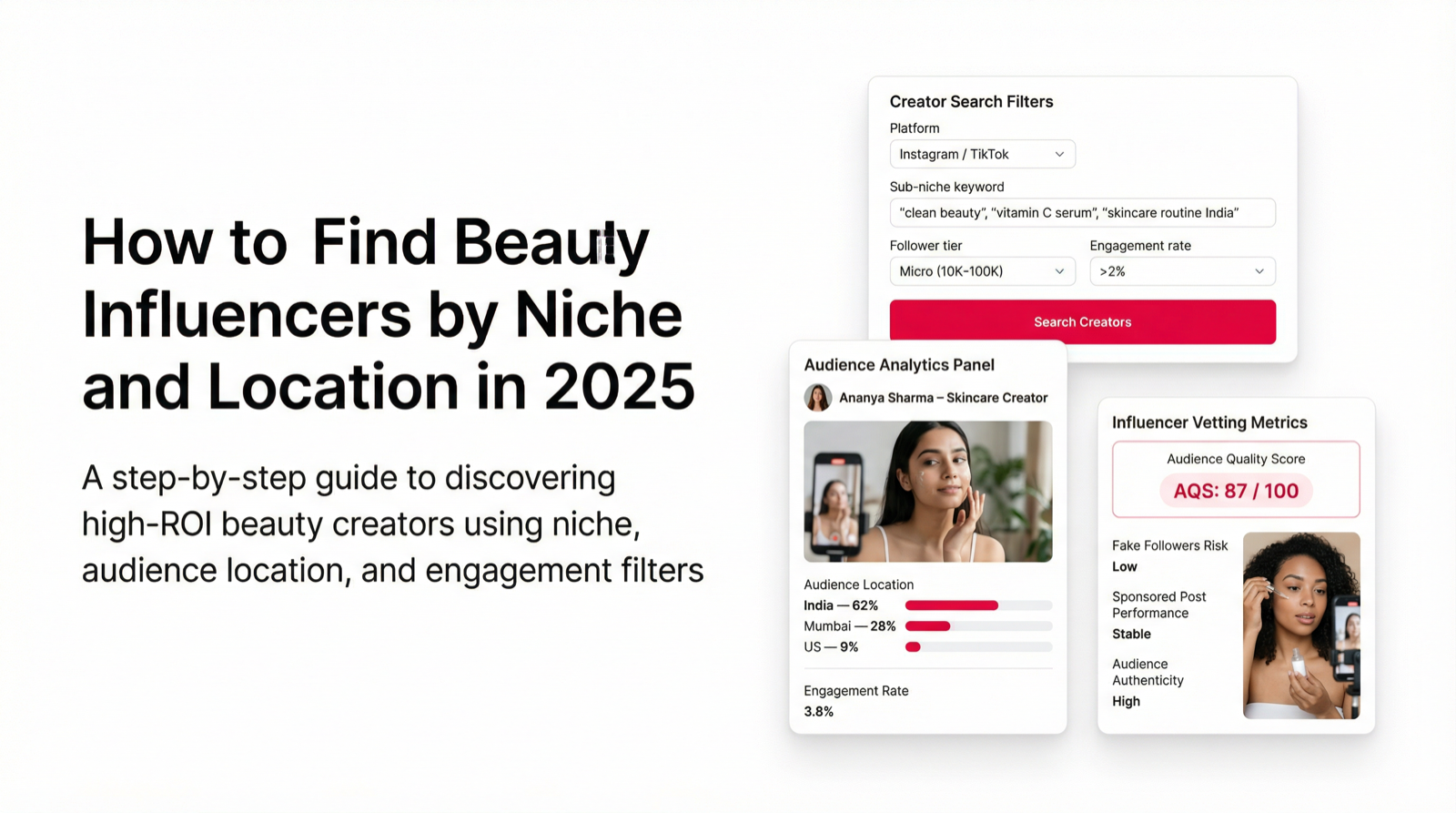
The fastest way to find beauty creators by niche and location is to use a dedicated influencer discovery platform with audience-level filters, not creator-level ones. Start with sub-niche keywords ("clean beauty," "dermatology skincare," "bridal makeup"), layer on audience city percentage, then check engagement rate and fake-follower score before you reach out. Done right, you go from brief to a shortlist of 10 vetted creators in under 30 minutes. This guide covers exactly how, including which filters matter, which platforms give them to you, and where most brands waste their budget.
Quick comparison
A side-by-side snapshot for readers who want the shortlist before the deep dive.
| Name | Best for | Starting price | Rating |
|---|---|---|---|
| Elev8or | Creator marketing platform built for niche and location-based discovery. Search beauty creators by sub-niche keyword, audience city percentage, engagement rate, and platform simultaneously. Built-in fake follower checker, Instagram pricing calculator, and 6 campaign types. 100K+ creator profiles indexed. | Free (20 credits). Paid from $49/mo, no annual contract. | ★5.0/5 |
| Modash | Strong discovery tool with audience demographic filters. Good for global campaigns. Pricing is higher and geared toward agencies and larger brands. | From $299/mo | ★4.0/5 |
| Upfluence | Full influencer marketing suite with CRM and campaign management. Location filters available but interface is complex for smaller teams. | Custom pricing (typically $800+/mo) | ★4.0/5 |
| HypeAuditor | Focused on audience quality and fraud detection. Good for auditing a pre-existing list but limited for open discovery workflows. | From $399/mo | ★3.0/5 |
| Aspire | Good for influencer relationship management and gifting campaigns. Discovery filters are less granular for beauty sub-niches compared to keyword-first platforms. | From $2,000/mo | ★3.0/5 |
| Collabstr | Marketplace model where creators list themselves. Good for finding micro-influencers quickly but limited audience location data and no fake-follower scoring. | Free to browse. Commission on deals. | ★3.0/5 |
How to Find Influencers in a Niche (The Right Way)
Finding influencers in a beauty niche is not about searching "beauty influencer" and scrolling Instagram. That approach surfaces the same 20 overexposed accounts with six-figure rates and audiences scattered across three continents. Real niche discovery means filtering by content theme, not category tag.
Platforms like Elev8or index creator bios, captions, and content themes so you can search "vitamin C serum" or "oily skin routine" and surface creators whose actual content matches your product, not just their profile category. This is the difference between finding 5,000 generic beauty accounts and 40 creators whose audience already buys what you sell.
- Use keyword search across captions, not just category tags. A creator tagged "beauty" might post 80% fashion and 20% makeup. Search content themes to find genuine niche fit.
- Filter by follower tier first. Decide your budget tier before you search. Micro (10K-100K) for trust and engagement, mid-tier (100K-500K) for broader launches, nano (1K-10K) for hyper-local test campaigns.
- Sort by engagement rate, not follower count. A 50K beauty micro-influencer with 4.5% engagement will outperform a 500K account at 0.8% engagement for almost any conversion-focused campaign.
- Cross-reference sponsored content history. If a creator has posted for three direct competitors in the past 90 days, their audience is already saturated with brand content from that category.
How to Find Influencers Based on Location
To find influencers based on location, filter by audience location percentage, not creator location. A creator living in Mumbai with 65% of their followers in the US does nothing for a Mumbai product launch. Always require a minimum audience percentage in your target geography before shortlisting anyone.
The two location signals every platform should provide:
- Creator location. Where the influencer is physically based. Useful as a rough starting filter, but not sufficient on its own. A creator can live in Delhi but built their following while living abroad.
- Audience location breakdown. The actual city and country distribution of their followers, expressed as percentages. This is the number that determines whether your campaign reaches your target market. Set a minimum: 40% in your target country, or 20%+ in a specific city for local campaigns.
For city-specific campaigns (launching a product in Bangalore, running a pop-up in Dubai), set the audience city filter to 20-25% minimum. For national campaigns in India, require at least 60% India-based audience. For US-focused campaigns, same rule applies. Elev8or surfaces both creator location and audience city breakdown in a single view, so you can apply both filters simultaneously and see exactly what percentage of each creator's audience sits in your target market.
How to Find Influencers in Your Area (Step-by-Step)
Finding local influencers, whether for a city-specific event, a regional product launch, or a geo-targeted ad campaign, requires a tighter filter stack than national campaigns. Here is the full workflow:
- Write a two-sentence brief first. What does your product do and who is your ideal buyer? Example: "Our vitamin C serum targets hyperpigmentation in women aged 25-35 in metro India who follow evidence-based skincare content." Every filter you apply flows from this brief.
- Open your discovery platform and set city-level audience filter. On Elev8or, search the beauty creator directory and apply audience city as your first filter. Set minimum 20% in your target city. This immediately cuts irrelevant results by 70-80%.
- Layer sub-niche keywords. Add content keywords that match your product: "hyperpigmentation," "vitamin C," "skincare routine." This narrows 10,000 beauty accounts down to the 100-200 who genuinely cover your category.
- Set follower tier for budget control. Nano (1K-10K) for hyperlocal test campaigns. Micro (10K-100K) for city-wide reach with strong conversion. Mid-tier (100K-500K) if you need broader visibility.
- Filter by minimum engagement rate. 2%+ for micro-influencers in beauty. Below 1% for this tier signals either bought followers or a disengaged audience.
- Run fake follower checks on your shortlist. Use the fake follower checker on the top 10-15 creators before reaching out. This step alone will save you from at least one bad campaign spend.
- Audit sponsored content manually. Look at the creator's last 5 paid posts. Does engagement hold up or drop by 50%+? Are competitors already represented? Is the content clearly labeled? These three checks take 10 minutes and prevent costly mismatches.
Top Beauty Sub-Niches to Target in 2026
Before you open any discovery tool, define which sub-niche your product belongs to. Beauty is not one niche, it is hundreds of overlapping communities. Matching to the right one is what makes the difference between a 2% conversion rate and a 0.1% one.
- Dermatology-backed skincare. Creators who reference clinical ingredients (niacinamide, retinol, hyaluronic acid, tranexamic acid) attract a high-intent, educated audience willing to pay premium prices for products backed by research. Best for: serums, actives, science-led skincare brands.
- Clean and cruelty-free beauty. Audiences are brand-conscious and pay a premium for ethical positioning. Conversion is strong for indie brands that lead with ingredient transparency or sustainability credentials.
- Ayurvedic and traditional Indian beauty. Rapidly growing segment, especially for audiences 25-40 returning to natural formulations. Strong regional performance in Tier-1 and Tier-2 Indian cities.
- Affordable and drugstore makeup. Broad audience, high engagement, lower rates. Best for mass-market launches, seasonal promotions, and brand awareness campaigns on tighter budgets.
- Inclusive beauty and deeper skin tones. Underserved but fiercely loyal. Creators in this space typically run above-average engagement because their followers feel genuinely represented. Brands that show up here authentically build long-term community trust.
- Hair care and scalp health. The breakout sub-niche of 2024-2026. Rising search interest in hair loss, scalp treatments, and protective styling has created a dedicated creator tier. Still less saturated with brand deals than skincare or makeup.
- Bridal and occasion makeup. Seasonal but high-converting. Audiences are in active purchase mode. Strong for premium cosmetics, pre-bridal skincare routines, and jewellery adjacency campaigns.
Beauty Creator Discovery by Platform: Instagram, YouTube, TikTok
Each platform produces different content formats and serves different campaign goals. Pick the platform based on what your campaign needs to achieve, not where you happen to have the biggest following.
Instagram beauty influencers
Instagram remains the dominant platform for beauty brand partnerships globally and in India. Reels drive strong top-of-funnel awareness, carousels work for educational skincare content, and Stories handle time-sensitive promotions. Purchase intent from Instagram beauty content is high: audiences are accustomed to tapping through to product pages directly from posts. Use the beauty creator search with sub-niche keywords and audience city filters to build your shortlist. For most beauty campaigns, Instagram micro-influencers with 10K-50K engaged followers in your target city outperform macro-influencers with ten times the reach but half the relevance.
YouTube beauty influencers
YouTube is the platform for long-form beauty content: full skincare routines, foundation comparisons, ingredient deep-dives, "get ready with me" videos. Content has a significantly longer shelf life than Instagram posts. A well-ranked YouTube video can drive search traffic for 12-24 months after upload. Best use case: product launches that benefit from detailed demonstration, complex formulas that need explanation, or brand-building campaigns where story depth matters more than immediate reach.
TikTok beauty influencers
TikTok is where beauty trends originate. The algorithm gives small creators viral potential overnight, and a single product mention in a trending format can generate enormous organic amplification. However, content lifecycle is short. TikTok beauty campaigns work best for fast trend participation, Gen Z product launches, and testing content hooks before scaling to Instagram. Note: for India-focused campaigns, Instagram Reels currently outperform TikTok for reach and purchase intent.
Filters That Separate Good Platforms from Great Ones
Most influencer discovery tools give you follower count and a broad category. That is not enough for beauty campaigns where niche fit and audience geography determine 80% of campaign ROI. Here is what a capable platform actually provides:
- Sub-niche keyword search across bios, captions, and content themes, not just category tags. Searches "retinol" or "glass skin routine" and surfaces genuine niche creators.
- Audience city percentage. What share of followers are in your target city. The most important filter for local and regional campaigns.
- Engagement rate range filter. Set a floor (2% for beauty micro-influencers) and surface only creators with real audience interaction.
- Follower tier selector. Nano, micro, mid-tier, macro segmentation for budget-aligned shortlisting.
- Platform selector. Search Instagram, YouTube, and TikTok independently, not as a combined pool.
- Recent activity filter. Creators who have posted within the last 30 days only. Active creators, active audiences.
- Sponsored content history. Visibility into past brand deals so you can check for competitor conflicts and audience response to paid content.
- Built-in fake follower detection. Inline audience quality scores without having to use a separate tool for every creator on your list.
Elev8or includes all of these filters in one place, with a free plan (20 credits, no annual contract) and paid plans from $49/month. The platform indexes 100,000+ creator profiles across Instagram, YouTube, and TikTok, with audience city breakdowns and built-in fake-follower scoring. No other tool at this price point combines sub-niche keyword search with city-level audience filtering in a single search interface.
Beauty Influencer Platform Comparison
Here is how the major platforms stack up for beauty creator discovery specifically. Pricing reflects 2026 public rates.
What Makes a Beauty Creator a Strong Brand Match Beyond Metrics
After applying filters and building a shortlist, there is a final layer no algorithm fully replaces: qualitative fit. Spend ten minutes per creator before you reach out.
- Visual aesthetic match. A matte, minimalist skincare brand looks wrong on a creator known for bold maximalist glam. Scroll their last 20 posts and ask if your product looks like it belongs there.
- Tone of voice alignment. Educational and ingredient-forward? Casual and relatable? Aspirational premium? Mismatch here produces content that feels forced and performs below benchmark.
- Sponsored vs organic engagement gap. Scroll to the comments on their last two or three paid posts specifically. If organic posts get 500 comments and paid posts get 20, the audience has learned to tune out their sponsorships.
- Genuine category connection. A creator who already talks about products like yours will produce more authentic content. Search their recent posts for organic mentions of your ingredient category or product type before you brief them.
- Competitor exposure check. Has the creator posted for a direct competitor in the last 60 days? If yes, their audience has already seen a pitch for the category and your campaign is competing with recency bias.
Common Mistakes Brands Make Finding Beauty Creators
- Searching by follower count first. Follower count measures reach, not relevance. Start with niche and audience location, then filter by tier as a budget constraint. Doing it backwards costs you every time.
- Filtering by creator location instead of audience location. The single most expensive mistake in influencer marketing. A creator in your target city with an internationally distributed audience cannot deliver a local campaign.
- Skipping the fake follower audit. Especially for creators with rapid recent growth or engagement rates that seem low relative to follower count. One undetected fraud partnership can absorb a significant chunk of your quarterly budget.
- Only checking organic performance, not sponsored performance. Some creators have loyal organic audiences that disengage the moment a brand deal appears. Always check both. The gap between the two is a direct signal of audience trust.
- Running one or two creator partnerships per campaign. Diversifying across five to ten micro-influencers in the same niche almost always outperforms a single macro deal at comparable or lower total cost, with better geographic coverage and lower risk concentration.
- Writing vague briefs. A vague brief produces generic content. Include your brand guidelines, the specific claim you want made, the exact product use case to demonstrate, and the target audience pain point to address. Creators perform better when they know exactly what success looks like.
Build Your Beauty Creator Shortlist
The gap between a campaign that converts and one that generates impressive-looking vanity metrics almost always comes down to creator selection. Get the selection right and everything downstream, content quality, audience response, conversion, gets easier.
The workflow is repeatable: define your sub-niche, filter by audience city percentage, check engagement and fake-follower score, review sponsored content history, then assess qualitative fit. That whole process should take under an hour for a shortlist of 10 vetted creators.
Browse beauty creators on Elev8or to apply all of these filters in one place. Free plan includes 20 credits to start. Once you have your shortlist, use the Instagram influencer pricing calculator to benchmark rates before you negotiate, and run every creator through the fake follower checker before committing budget. Right creator, fair rate, clean audience. That is the foundation every successful beauty campaign is built on.
Frequently Asked Questions
How do I find beauty influencers in a specific city?
How to find influencers in a niche?
How to find influencers based on location?
How do I find influencers in my area for a local campaign?
What are the best sub-niches in beauty for influencer marketing in 2026?
What is the difference between creator location and audience location?
Do beauty micro-influencers outperform mega-influencers?
Which platform is best for finding beauty creators in India?
How do I check if a beauty influencer has fake followers?
How much do beauty influencers charge for a sponsored post?

About the author
Elev8or Team
Elev8or Editorial Team
Elev8or researches creator pricing, campaign performance, and influencer software workflows to turn scattered market signals into practical decision guides for brands and creators.


